[CC]P
site
center 2005
practice
wonderland
urbi/suburbi
research
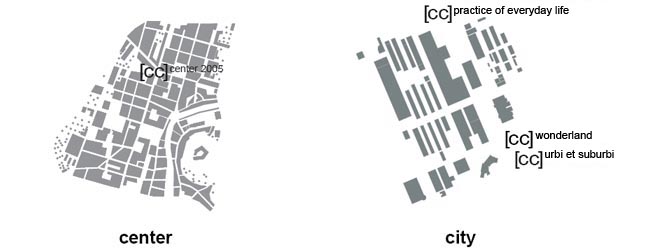
[C - center]
City centers are contemporary forms of open-program system where public
space is partly publicly partly privately owned. Private ownership is
manifested through a mode of restriction (capsules), which regulates participants’
behaviour through the mechanisms of representation of power. Space is
apparently open, yet the private ownership with private regulations (security
services, surveillance systems – cameras and alarms, restrictions of movement,
staying and expression…) reduces the public to a flux of functionally
defined individuals – users of city infrastructure and/or consumption.
City centre redefines the city from a space of free movement and expression
into a space of controlled functional behaviour.
[C - city]
Shopping centers are a contemporary form of closed-program system (capsule)
where public space is privately owned. Private ownership implies a special
regulatory framework which regulates participants’ behaviour in a carefully
defined direction, the direction of instant consumption. Space is a hybrid;
though a flux of people gives to it the appearance of a public space,
the private ownership with private regulations (security services, surveillance
systems – cameras and alarms, restrictions of movement, staying and expression…)
reduces the public to a flux of functionally defined individuals – consumers.
Shopping center redefines the city from a space of free movement and expression
into a space of controlled functional behaviour.